I recently acquired this beauty from a lady who is downsizing her collections of Stuff. She was told it was a doll quilt when she bought it, and is circa 1890. I can certainly imagine a young lady making this as a sampler of sorts. It is mostly velvets, but has been worn away with time and use. It is still a beautiful example of crazy quilting.
What Victorian era quilt is complete without a fan? There is, of course, the requisite seam work on each blade of the fan. I am enjoying copying these designs on my own quilts. The real thing is so much better than copying from a book. Of course, I do have way more books than any sane person should have.
This motif looks like a sunflower to me. The fabric to the left is a threadbare rose colored velvet and the one below was a gold and orange striped velvet.
And what girl of Scottish descent can resist the thistle? One of them has apparently blown away in time, but you can still see where it was. The background was orange and to the right looks to be an olive green.
Possibly forget-me-nots? The purple above is still very vibrant.
This is the back. It is mostly the fabric on top, with a smaller band of the other. Both were black, now faded to grey. I think the backing on a quilt can be just as interesting as the top.
5/16/13
5/9/13
May Crazy Quilt Journal Project Block
Have you ever found that with a crazy quilt you made? Whenever I look back at a block, I "discover" something new.
This is my 5th block for the 2013 CQJP:
The little girl is my grandmother, circa 1918. As you can see, I tatted a tiny flower for her and embroidered a duck pull toy. The frame was pinked with my awesome vintage pinking machine and embroidered in an aesthetic style.
I also tatted the cross from a pattern in Tatting Collage by Lindsay Rogers. I had originally planned to put it below the picture, but it was too dark. The lace that it landed on is from my stash of antiques, as is the flower and leaf surrounded by silk ribbon french knots. Check my etsy page for an awesome holder for your tatting needles, hand made out of Texas mesquite.

The mixing bowl and rolling pin are my own design. And yes, I do use a vintage wooden rolling pin with green handles. I think old things should also have a function. The mixing bowl reminds me of some of the Pyrex bowls that have been passed down to me.
Last but not least, my little tractor. We do not use John Deere, but love International Harvester. The design is from an Aunt Martha. I had to shrink it quite a bit to fit, but it was a lot easier than trying to draw one.
5/2/13
Market Bound
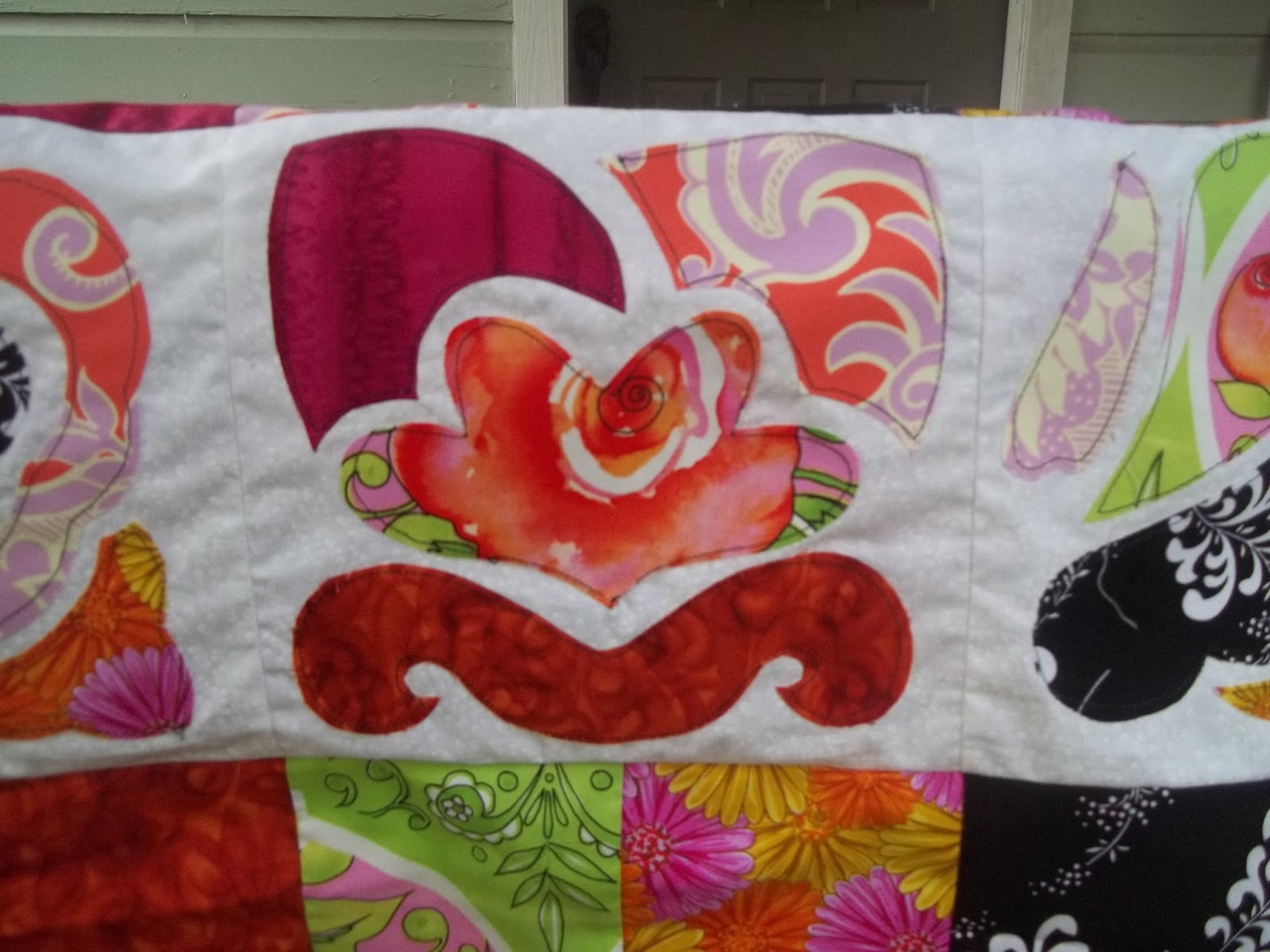
This week I've been getting ready for the Rockport (Texas) Market Day on Saturday. I've made a casserole tote to showcase that pattern and am working on two of the Bohemian Tile table runners. The tops are done and I am hoping to get the backing put on them tonight, if I can find something in my stash to use.
I designed this runner after reading Tile Quilt Revival by Carol Gilham Jones and Bobbi Finley. If you haven't read the book, I recommend it. They give the history of the tile quilt, tell you how to design your own pattern, and include patterns.
The tile quilt is perfect for showcasing the big, modern prints that catch our eye, but leave us stumped. Smaller prints work just as well and let you see the design of the applique pieces. Speaking of applique, it is not my forte. But the simplicity of the tile quilt makes applique much less scary. For Bohemian Tile, I used the light Heat & Bond or Wonder Under and then used a straight stitch inside the perimeter of each shape. No tucking under or satin stitch. For a larger quilt, or one that will get a lot of wear, I would probably not use this raw edge technique. This runner uses 6 fat quarters.
For these lighter (I think of saltwater taffy) blocks, I used a dark brown thread for my straight stitch.
On the other runner (orange slice candy?) I used black thread. These will all be tyed when finished, but could easily be quilted.
I designed this runner after reading Tile Quilt Revival by Carol Gilham Jones and Bobbi Finley. If you haven't read the book, I recommend it. They give the history of the tile quilt, tell you how to design your own pattern, and include patterns.
For these lighter (I think of saltwater taffy) blocks, I used a dark brown thread for my straight stitch.
On the other runner (orange slice candy?) I used black thread. These will all be tyed when finished, but could easily be quilted.
Subscribe to:
Posts (Atom)